Read Time5 Mins
Family offices deal with billions in assets—public equities, private equity, real estate, venture capital, hedge funds, multi-currency accounts, and illiquid investments. Yet, many still rely on outdated reports, fragmented systems, and dashboards that fail to deliver real insights. According to the Family Office Operational Excellence Report 2024 by Campden Wealth, 40% of participants cited excessive reliance on spreadsheets, while 38% still manually aggregate financial data.
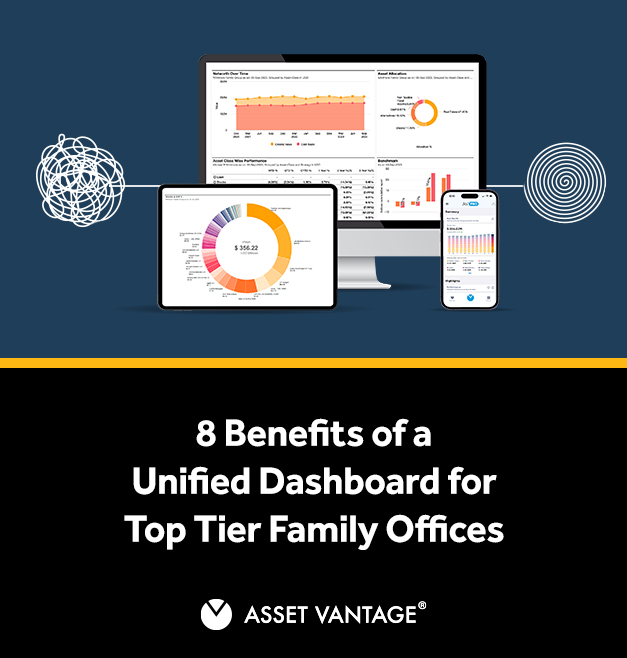
To overcome these inefficiencies, the dashboard of a modern investment portfolio management software should do more than just display numbers—it should turn raw data into structured intelligence that helps you:
- TRACK – every investment—public and private—across entities, geographies, and advisors<
- MEASURE – IRR, TWR, and multi-period performance against benchmarks
- MONITOR – liquidity across illiquid and liquid investments
- DRILL – down to performance metrics by strategy, advisor and other parameters.
- ANALYZE – asset allocation shifts and long-term investment trends
If your current dashboard isn’t doing all this, it’s time to upgrade.
The Problem: Most investment portfolio management software lack the power of a customisable dashboard that tells you everything you need to know with a single click.
Inefficient dashboards make data harder to interpret instead of making it easier and fall short on critical insights. If your investment portfolio management software can’t provide a clear view across entities, asset classes, advisors, and geographies; you risk making decisions based on incomplete data.
- Generic Templates That Don’t Fit Family Office Structures: Managing multiple trusts, LLCs, partnerships, and offshore entities? Pre-built dashboards aren’t built for that complexity.
- Fragmented Data That Misses the Full Picture: Can your dashboard combine public market investments, real estate, alternative assets, and private equity to provide a full view of your net worth? If not, you’re missing critical insights.
- No Visibility into Illiquid Investments: AIFs, private equity commitments, and hedge funds don’t fit neatly into a basic performance report. You need to track uncalled capital, commitments, and liquidity exposure.
- No Advisor-Level Performance Tracking: If you can’t see which wealth advisors are delivering actual returns, how do you decide where to allocate more capital?
- Limited or No Customization: If you can’t customize your dashboard to show the exact KPIs you need, you’re making decisions based on someone else’s priorities, not yours.
- No Up-to-Date Performance Insights: Waiting for end-of-month reports is too slow. By the time you get the data, the opportunity to act has passed.
If your dashboard fails in even one of these areas, you’re not maximizing your portfolio returns and you’re constantly navigating through multiple unknowns.
The Solution: Fully Customisable Dashboard in AV PRO
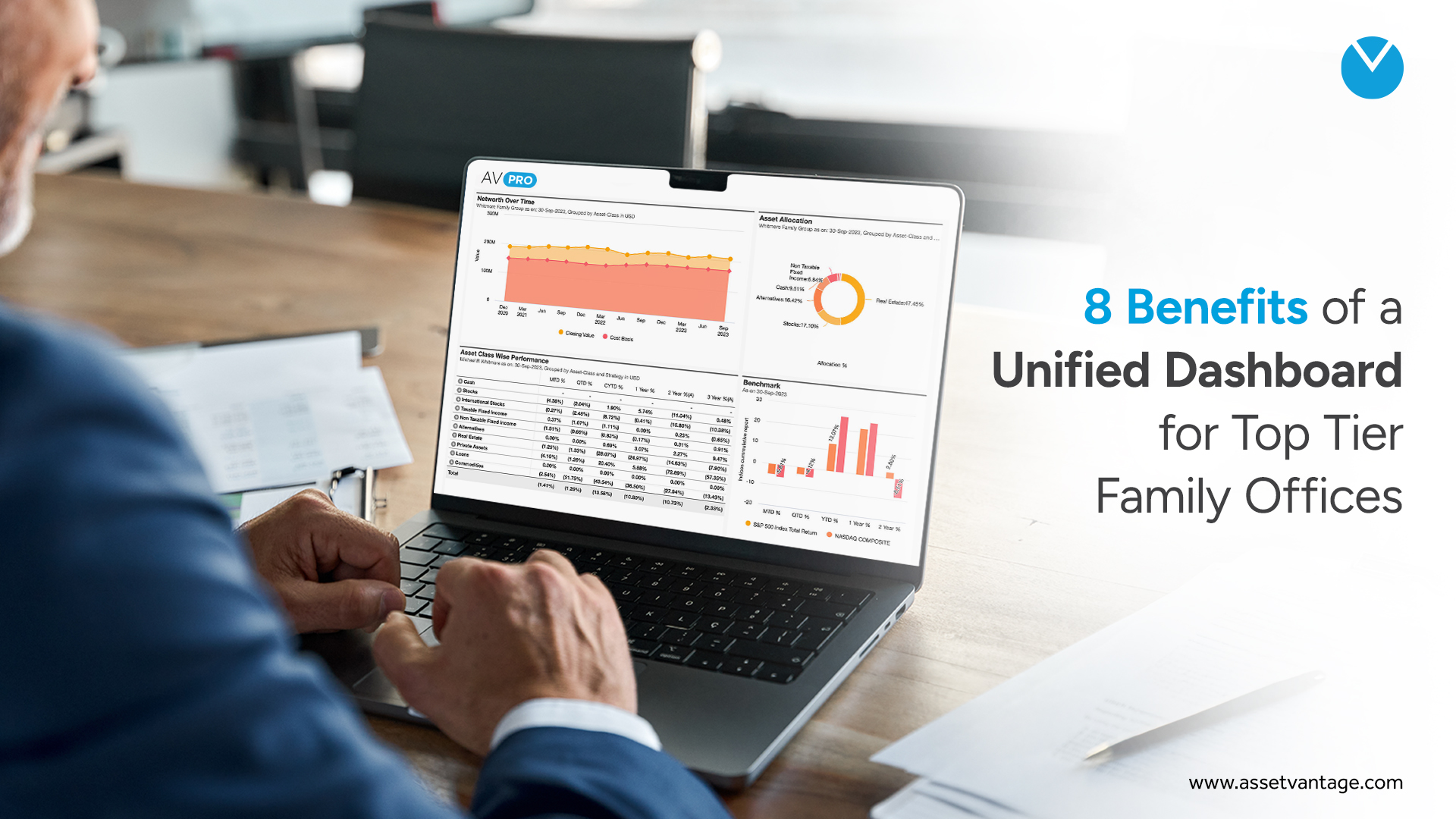
Your dashboard should work for you, not against you. Asset Vantage (AV) investment portfolio management software delivers dashboards designed specifically for family offices—built to handle the complexities of managing multi-entity, multi-asset, and multi-currency wealth data in real time.
1.Fully Customizable Views: AV’s consolidated dashboard lets you filter and view performance by entity, advisor, asset class, geography, investment strategy, or any metric that matters—ensuring you always see the data in the way that best supports your decision-making.
2.Single Source of Truth: AV’s custom dashboard consolidates public equities, hedge funds, real estate, private equity, venture capital, offshore holdings, and bank accounts—giving you a clear, unified view of your entire portfolio.
3.Real-Time IRR, TWR & Benchmarking: No more waiting for static reports. AV’s consolidated dashboard continuously updates with live multi-period performance tracking (MTD, QTD, YTD, 3Y, 5Y, etc.), giving you instant visibility into returns and benchmark comparisons—so you can make confident decisions faster.
4.Advisor Performance Breakdown: Which advisors are adding value? AV’s consolidated dashboard gives you a clear breakdown of performance by advisor, investment strategy, and entity, so you can see exactly where returns are coming from—and where adjustments are needed.
5.Illiquid Asset Tracking: Private equity, venture capital, hedge funds—these investments don’t follow traditional reporting cycles. With AV’s intelligent dashboard, you can monitor private equity commitments, track uncalled capital, and analyze fund distributions alongside liquid assets—all in one place.
6.Comprehensive Risk & Liquidity Analytics: A strong dashboard doesn’t just show numbers—it highlights risks before they become problems. With AV, you get real-time portfolio concentration insights, investment policy tracking, and cash flow projections to help you anticipate risks and maintain liquidity when you need it most.
7.Multi-Currency & Global Holdings Report: Your family office operates across multiple jurisdictions—your dashboard should too. AV automatically tracks and reconciles multi-currency investments, ensuring you always see accurate performance in both base and local currencies.
8.Built-In Financial Accounting: No more toggling between multiple platforms. AV’s intelligent dashboard seamlessly automates data aggregation, reconciliation, and financial reporting—ensuring all your critical financial data stays in sync.
With Asset Vantage investment portfolio management software, you’re not just tracking wealth—you’re unlocking insights that drive smarter decisions.
Your Investments Deserve More Than Just Data—They Need Intelligence
Your investment data should work for you, not against you. How many decisions are delayed because your dashboard isn’t giving you the full picture?
Asset Vantage family office software ensures excellence and breadth in system design and capabilities. Developed by a family office and a technology group, the platform is designed to track wealth (both liquid and illiquid), multi-asset portfolios, and data security needs of high-net-worth families.
With performance tracking, advisor benchmarking, liquidity and risk analytics, and multi-currency reporting, AV’s intelligent dashboard gives you unparalleled control, clarity, and confidence in tracking both liquid and illiquid assets across entities.
By consolidating investment data, accounting, and risk analytics into a single source of truth, AV ensures that every decision is backed by accurate, real-time intelligence—eliminating blind spots and outdated reports.
And in the long run? AV helps simplify intergenerational wealth transfer, ensuring continuity, structure, and complete financial transparency for future generations.
The right data makes all the difference. The right dashboard gives you the edge.
Don’t settle for outdated tools. See the power of Asset Vantage Investment portfolio management software for yourself.